

Contemplate on differentiation between surrogacy vs adoption, and which is the right for me, then must be considering this content pros, and cons to make a big deciding decision. You want to build a family. This is one of the most important things you will ever do.
When you face infertility or other reasons that prevent natural conception, you look for other ways to become a parent. This often leads to a choice between surrogacy vs. adoption. Both paths have the same goal. Both require time, money, and emotional work. However, they are very different experiences.
Surrogacy Vs Adoption – Which Is The Right For Me?
| Factor | Surrogacy | Adoption |
|---|---|---|
| Biological Connection | Possible biological link to one or both parents. | No biological connection to adoptive parents. |
| Process Duration | Typically 12–24 months. | May vary from several months to years. |
| Legal Requirements | Requires surrogacy agreements and legal approvals. | Requires adoption home studies and court procedures. |
| Cost | Generally higher due to medical and legal expenses. | Can vary significantly depending on adoption type. |
| Pregnancy Experience | Parents can participate throughout the pregnancy journey. | No involvement during pregnancy. |
| Availability | Dependent on finding a suitable surrogate. | Dependent on agency procedures and child availability. |
| Family Building Goal | Ideal for those seeking a genetic connection. | Ideal for those wishing to provide a loving home. |
You must weigh the pros and cons to see which option matches your life and your values. Nowadays, the world has grown up with the latest technology, and equipped with benefits, for instance, a random surrogate mother can birth a baby just for you under the government laws or regulations, especially in India. In other countries, the process of surrogacy is so disparity with their government rules. For amenities in their family or life, then you choose one of them with aforementioned key elements.
Differentiation Between Types Of Surrogacy

Differentiation Between Types Of Surrogacy
Surrogacy means another woman, the surrogate, carries a baby for you. It is a way to have a child who is often biologically related to you. You should know the difference between the two main types.
Traditional Surrogacy
In traditional surrogacy, the surrogate uses her own egg. This is combined with the father’s sperm or donor sperm through artificial insemination. Because she provides the egg, the surrogate is the biological mother of the child. This creates complex legal issues. Some surrogates may want to keep the baby after birth. Because of this, traditional surrogacy is less common than it used to be. It can be cheaper, but the emotional and legal risks are often too high for many parents.
Gestational Surrogacy
This is the most common form of surrogacy today. Doctors create an embryo in a lab. They use your egg or a donor egg, and sperm from the father or a donor. The doctor then places this embryo into the surrogate. She has no biological link to the child. This makes the legal process much clearer. It is an expensive and medical-heavy process. You will need lawyers and doctors to handle the contract and the IVF procedure. Most intended parents prefer this method because the surrogate does not have a genetic claim to the baby.
The Surrogacy Process
You usually start by finding an agency. An agency helps you find a surrogate who fits your needs. They manage the screening process. They make sure the woman is healthy and emotionally ready. You will have a legal contract that outlines rights, money, and expectations. After that, the medical part begins with IVF and prenatal care. Finally, you have legal steps to make sure your names go on the birth certificate. This usually involves a court order signed before the baby is born.
Comprehend Adoption With Its Fundamentals
Adoption is a legal process. Biological parents end their rights, and you become the legal parent. This is a life-long commitment to a child who needs a home.
Type Of Adoption In The World
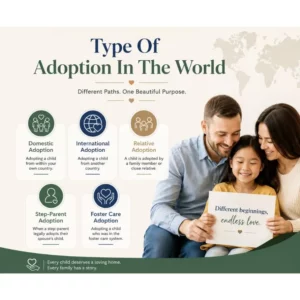
Type Of Adoption In The World
Domestic infant adoption happens within your own country. You often work with an agency to match with a birth mother. You might have an open adoption, where you keep in touch with the birth family.
|
Type of Adoption |
Description |
Common Characteristics |
|
Domestic Adoption |
Adoption of a child within the same country where the adoptive parents reside. |
Governed by national laws and often involves local agencies or government authorities. |
|
International Adoption |
Adoption of a child from a different country. |
Requires compliance with the laws of both countries and international adoption regulations. |
|
Infant Adoption |
Adoption of a newborn or very young child. |
Often involves placement shortly after birth and may have longer waiting periods. |
|
Foster Care Adoption |
Adoption of a child who is currently in the foster care system. |
Frequently supported by government programs and may involve older children or sibling groups. |
|
Open Adoption |
Birth parents and adoptive families maintain some level of communication and contact. |
May include letters, photos, phone calls, or in-person visits. |
|
Semi-Open Adoption |
Limited communication occurs through an agency or intermediary. |
Personal information is often partially shared while maintaining privacy. |
|
Closed Adoption |
No ongoing contact or identifying information is shared between birth and adoptive families. |
Records may be sealed depending on local laws. |
|
Relative (Kinship) Adoption |
A child is adopted by a family member such as a grandparent, aunt, uncle, or sibling. |
Helps maintain family connections and cultural continuity. |
|
Stepparent Adoption |
A stepparent legally adopts their spouse’s child. |
Common when one biological parent is absent or relinquishes parental rights. |
|
Adult Adoption |
One adult legally adopts another adult. |
Often used for inheritance, caregiving, or formalizing long-term family relationships. |
|
Special Needs Adoption |
Adoption of a child with physical, developmental, emotional, or medical needs. |
May qualify for financial assistance or support services in some countries. |
|
Sibling Adoption |
Adoption of two or more siblings together. |
Prioritizes keeping brothers and sisters in the same family environment. |
|
Single-Parent Adoption |
Adoption by an unmarried individual. |
Permitted in many countries, subject to eligibility requirements. |
|
LGBTQ+ Adoption |
Adoption by individuals or couples who identify as LGBTQ+. |
Legal recognition and eligibility vary by country and region. |
|
Identified (Independent) Adoption |
Birth and adoptive parents connect directly without a traditional agency match. |
Legal oversight is still required to finalize the adoption. |
Foster care adoption involves children already in the state system. These children have often faced trauma or neglect. The government provides support and subsidies. However, you must be ready for the specific emotional needs of children who have been separated from their first families.
International adoption means you adopt a child from another country. This process is complex. It involves immigration laws from both the home country and your own. It takes a long time, and you must prepare to support the child’s connection to their birth culture.
The Adoption Process
First, you must complete a home study. A social worker visits your home. They talk to you about your life, your marriage, and your readiness to be a parent. This is a standard requirement. You also prepare all your legal and financial papers.
Next, you enter the matching phase. In domestic adoption, you wait for a birth mother to choose you. In foster care, you wait for a placement. This can take months or even years. Once a child is placed, you have a period of supervision. Finally, you go to court to finalize the adoption. The judge signs the papers, and the child is yours legally.
Do It The Comparison Between Surrogacy Vs Adoption – Which Is The Right For Me
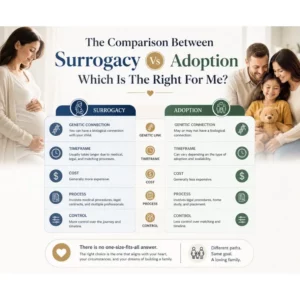
The Comparison Between Surrogacy Vs Adoption
When you look at the big picture, the differences become clear.
|
Comparison Factor |
Surrogacy |
Adoption |
|
Path to Parenthood |
A surrogate carries a child for the intended parent(s). |
Parent(s) legally adopt a child born to another individual or family. |
|
Biological Connection |
Often allows one or both parents to have a genetic connection to the child. |
Usually no biological connection to the child. |
|
Pregnancy Experience |
Intended parents may be involved throughout the pregnancy journey. |
No pregnancy involvement; parenthood begins after placement or legal adoption. |
|
Time to Parenthood |
Typically 12–24 months, depending on matching and medical processes. |
Can range from several months to several years, depending on the adoption type and regulations. |
|
Cost Range |
Generally higher; often ranges from $95,000–$275,000+ (varies by location). |
Usually lower overall but varies widely based on domestic, foster care, or international adoption. |
|
Medical Procedures |
Requires fertility treatments, embryo transfer, and prenatal care. |
No fertility-related medical procedures required. |
|
Legal Process |
Involves surrogacy contracts, parental rights documentation, and legal agreements. |
Requires adoption approval, home studies, background checks, and court finalization. |
|
Control Over Early Development |
Greater involvement in prenatal care and pregnancy decisions. |
Limited or no involvement before the child is placed with the adoptive family. |
|
Eligibility Requirements |
Depends on fertility clinic, legal regulations, and financial readiness. |
Requires meeting adoption agency or government eligibility standards. |
|
Emotional Considerations |
May involve emotional complexities related to fertility treatments and surrogate relationships. |
May involve navigating birth family relationships and adjustment to adoption processes. |
|
Availability of Newborns |
Allows intended parents to welcome a child from birth. |
Newborn adoption opportunities may be limited depending on demand and location. |
|
Opportunity to Help a Child in Need |
Creates a new path to parenthood through assisted reproduction. |
Provides a permanent family for a child who needs one. |
|
Flexibility in Family Building |
May offer options using intended parents’ eggs, sperm, or donor gametes. |
Adoption options include infants, older children, sibling groups, and special-needs children. |
|
Potential Challenges |
High financial investment, medical uncertainties, and legal complexities. |
Waiting periods, matching uncertainty, and varying adoption regulations. |
|
Best Suited For |
Individuals or couples seeking a biological connection and involvement in pregnancy. |
Individuals or couples focused on providing a loving home regardless of genetic connection. |
Examine The Emotional & Legal Compliances
Surrogacy is about the pregnancy. You are part of the process from the start. You deal with the medical steps and the surrogate relationship. Adoption is about the child’s story. You must support a child who has their own history and family background. Both paths involve grief. With surrogacy, you might grieve the pregnancy you could not have. With adoption, you might deal with the complex feelings of infertility or the reality of the child’s loss.
|
If You Value… |
Consider… |
|
Having a biological connection to your child |
Surrogacy |
|
Experiencing the journey from pregnancy to birth |
Surrogacy |
|
Lower overall financial costs |
Adoption |
|
Providing a home to a child in need |
Adoption |
|
Greater control over prenatal care |
Surrogacy |
|
Avoiding fertility treatments and medical procedures |
Adoption |
|
Welcoming a child of various ages |
Adoption |
|
Building a family through assisted reproduction |
Surrogacy |
Legal rights are also different. In surrogacy, you work to prove you are the parents before the child is even born. In adoption, you start as a stranger to the child. You have to wait for the biological parents to end their rights before you can gain yours.
What Are The Financial Investment If Choose Surrogacy For Parenthood?

What Are The Financial Investment?
Surrogacy is a high-cost option. You pay for the surrogate’s medical bills, her legal fees, and often her compensation. You also pay for IVF and other medical costs. If the first try does not work, you pay again.
|
Expense Category |
Estimated Cost Range (USD) |
Description |
|
Surrogate Compensation |
$35,000 – $70,000+ |
Payment to the surrogate for carrying the pregnancy. Experienced surrogates may receive higher compensation. |
|
Agency Fees |
$15,000 – $40,000 |
Covers matching, screening, coordination, and support services provided by a surrogacy agency. |
|
IVF & Fertility Treatments |
$15,000 – $30,000+ |
Includes egg retrieval, embryo creation, embryo transfer, and fertility medications. |
|
Medical Expenses |
$5,000 – $20,000+ |
Prenatal care, specialist visits, delivery costs, and other pregnancy-related medical expenses not covered by insurance. |
|
Legal Fees |
$5,000 – $15,000 |
Drafting and reviewing surrogacy agreements, parental rights documentation, and court filings. |
|
Insurance Costs |
$5,000 – $30,000 |
Health insurance for the surrogate and possible life insurance coverage during the pregnancy. |
|
Screening & Psychological Evaluations |
$1,000 – $5,000 |
Medical, psychological, and background screening for the surrogate and intended parents. |
|
Travel & Accommodation |
$1,000 – $15,000+ |
Travel expenses for medical appointments, embryo transfers, and delivery if located in another city or country. |
|
Maternity-Related Allowances |
$2,000 – $10,000 |
Covers maternity clothing, childcare, housekeeping, lost wages, and miscellaneous pregnancy expenses. |
|
Birth & Postpartum Expenses |
$1,000 – $10,000 |
Recovery support, newborn care costs, and additional postpartum expenses. |
|
Contingency Fund |
$10,000 – $30,000+ |
Reserved for unforeseen medical procedures, pregnancy complications, or multiple embryo transfers. |
|
Total Estimated Investment |
$95,000 – $275,000+ |
Overall cost varies significantly based on country, agency, medical needs, insurance, and surrogacy arrangement. |
Adoption costs can also be high. Agency fees, legal costs, and home study fees add up fast. International adoption usually costs the most due to travel and foreign laws. Foster care adoption is often the least expensive, as the state covers many of the costs.
Clues To Make A Decision For Surrogacy Vs Adoption In Hard Core Period
You have to look at your own life to make the right choice. Ask yourself these questions to help you decide.
- Is a genetic link to your child important to you? If yes, surrogacy is the most direct path.
- Are you okay with the wait time in adoption? It is often uncertain and can take years.
- Do you have the budget for the high costs of surrogacy?
- Are you ready to support a child who may have a difficult history, as is common in adoption?
Essential Tips For Moving Forward – Surrogacy Vs Adoption
Talk to your partner. Make a list of what matters most to you. Look for local support groups. Meeting others who have done this can give you real insight. You should also speak with a lawyer who specializes in family law. They can explain the specific laws in your area, which is a major factor in both surrogacy and adoption.
There is no right or wrong choice here. There is only the choice that works for your family. Both paths lead to the same result: becoming a parent. Whether you choose the medical process of surrogacy or the legal process of adoption, the result is the same. You will have a child to raise. Focus on what you can handle and what you want for your future. You have the power to create the family you have always wanted.
Final Wording – Surrogacy Vs Adoption
We’re always candor on all required topics, even if they are hard to comprehend to you or easy to read. As same as, this content disclose the prep differentiation between surrogacy vs adoption. Most couples make a decision towards adoption due to heavy pressure of family talks, friend offensive environment, and other issues. But, nowadays, technology has been sharp or incredible to make impossible things to possible one.
Surrogacy is the second name of it. In surrogacy, a surrogate mother support to birth a baby for you under types of, for instance, gestational or traditional surrogacy which depends on numerous countries or their government rules.
We hope that you read this content, and make the decision focused. Along with it, you can also read the other contents which is established on similar topics, for instance, www.worldfertilityservices.com, to enhance the conception power by reading influence contents.

Devender Gill is an experienced medical blogger & writer on the healthcare researcher with a strong focus on numerous treatments based on the official info from clinics aross network. He Specializes in creating accurate, easy-to-understand medical content covering, medical topics, for instance, IVF, Surrogacy, IUI, ICSI, and other essential ones.
Table of Contents

 WhatsApp us