
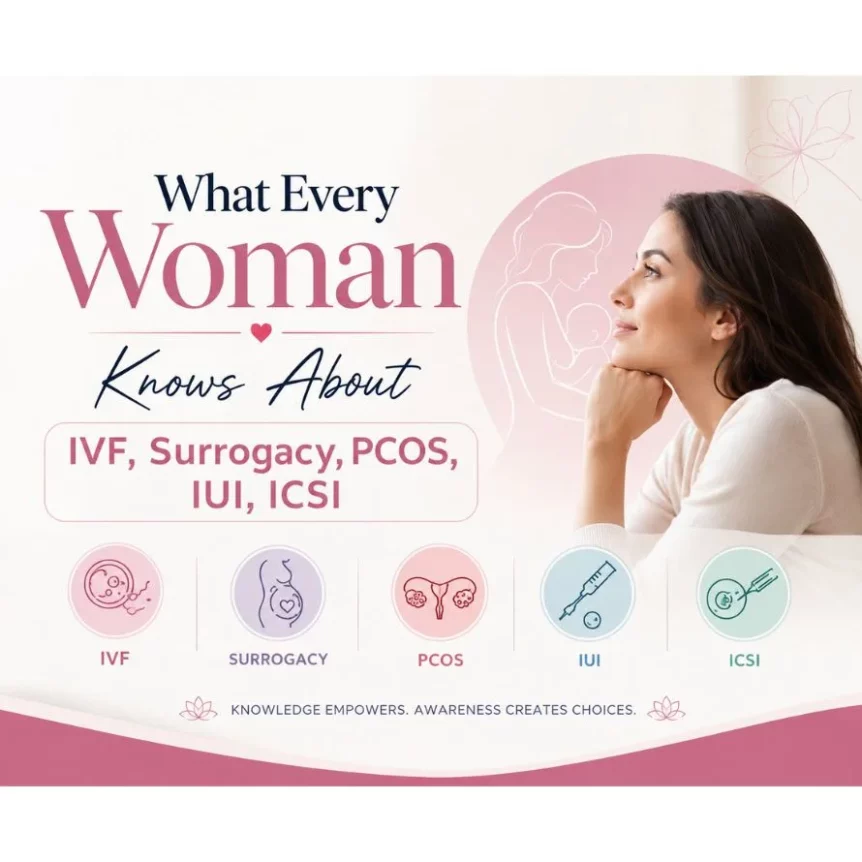
You sit in the waiting room, staring at a magazine you are not actually reading. You look at the other women and wonder if they are on their first cycle or their fifth. You are all part of a shared experience that few people outside these walls truly understand. This is the reality for anyone researching what every woman knows about IVF, surrogacy, PCOS, IUI, and ICSI.
What Every Woman Knows About IVF, Surrogacy, PCOS, IUI, ICSI
| Treatment / Condition | What It Is | Who May Benefit | Key Advantages | Important Considerations |
|---|---|---|---|---|
| IVF (In Vitro Fertilization) | Eggs are fertilized with sperm in a laboratory and embryos are transferred to the uterus. | Women with blocked tubes, advanced maternal age, unexplained infertility, or male factor infertility. | High success rates, embryo testing options, donor egg/sperm possibilities. | Multiple treatment cycles may be required. |
| IUI (Intrauterine Insemination) | Prepared sperm is placed directly into the uterus during ovulation. | Mild male infertility, unexplained infertility, single women, and same-sex couples. | Less invasive and more affordable than IVF. | Success rates are generally lower than IVF. |
| ICSI (Intracytoplasmic Sperm Injection) | A single sperm is injected directly into an egg during IVF. | Severe male infertility or previous fertilization failure. | Improves fertilization chances in male-factor cases. | Usually performed as part of IVF treatment. |
| PCOS (Polycystic Ovary Syndrome) | A hormonal disorder affecting ovulation and fertility. | Women experiencing irregular periods, weight gain, acne, or infertility. | Can often be managed successfully with lifestyle changes and fertility treatment. | Requires ongoing medical management. |
| Surrogacy | A surrogate carries a pregnancy for intended parents. | Women unable to carry a pregnancy or couples facing medical fertility challenges. | Allows biological parenthood when pregnancy is not possible. | Legal requirements vary significantly by country. |
International Surrogacy Legality Overview
| Country | Surrogacy Status | Type Allowed | Intended Parents | Key Legal Notes |
|---|---|---|---|---|
| United States | Permitted in many states | Commercial & Altruistic | Singles, couples, LGBTQ+ (state-dependent) | Laws vary by state. |
| Canada | Legal | Altruistic Only | Domestic and international intended parents | Commercial payments prohibited. |
| United Kingdom | Legal | Altruistic Only | Singles and couples | Parental order required. |
| Australia | Legal | Altruistic Only | Eligible intended parents | State-specific regulations apply. |
| New Zealand | Legal | Altruistic Only | Qualified intended parents | Ethics approvals may apply. |
| Georgia | Legal | Commercial | Mainly married heterosexual couples | Strong intended-parent protections. |
| Ukraine | Legal | Commercial | Married heterosexual couples | Well-established legal framework. |
| Greece | Legal | Regulated Compensation | Domestic and international parents | Court approval required. |
| Kazakhstan | Legal | Commercial | Eligible intended parents | Surrogacy contracts recognized. |
| Colombia | Generally Permitted | Compensated Arrangements Possible | Domestic and international intended parents | Legal guidance recommended. |
| South Africa | Legal | Altruistic | Qualified intended parents | Court confirmation required. |
| Portugal | Limited Legal Access | Altruistic | Medical necessity required | Strict regulation. |
| Belgium | Permitted | Primarily Altruistic | Case-by-case basis | Clinic-specific policies. |
| Netherlands | Legal | Altruistic Only | Eligible intended parents | Commercial surrogacy prohibited. |
The medical path to building a family is rarely a straight line. It is a mix of science, waiting, and often, emotional exhaustion. This guide moves past surface-level definitions to address the realities of these procedures. It is for those who are tired of vague brochures and want to understand the actual steps ahead.
Sightedness IVF Challenges & PCOS Procedure
Sightedness IVF Challenges & PCOS Procedure
Many women begin their path to conception by identifying a specific medical barrier. Polycystic Ovary Syndrome (PCOS) is one of the most common diagnoses you will hear. It is not just one thing. It is a complex set of symptoms that makes ovulation unpredictable. You might experience irregular periods, acne, or excess hair growth.
The Silent Impact Of Hormonal Imbalance – IVF In India
PCOS is often linked to insulin resistance. When your body struggles to process insulin, it triggers an over production of androgens, which are male hormones. This imbalance disrupts your ovaries making it hard to release an egg. Beyond the personal symptoms, this hormonal state takes a toll on your mental health. It can lead to mood swings, anxiety, and a feeling of disconnect from your inner body structure.
Alternative Common Barriers To Conception During Procedure
While PCOS is common, it is not the only hurdle. Several women detected themselves in the clinic due to secondary infertility, where they have conceived before, but struggle to do so again. Others faces, for instance, diminished ovarian reserve DOR, which means the quantity or quality of eggs has declined. Male factor infertility is also a frequent reality, affecting roughly half of all cases. When these factors collide, you often move from natural attempts to assisted reproduction.
Initial Steps – Exploring Less Invasive IVF Procedure – What Every Woman Knows
If you’re just beginning, your IVF doctors might suggest intrauterine insemination which knows as IUI. This process is for less invasive than IVF. It involves placing washed sperm directly into your uterus around the period of ovulation.
It is often a initial choice of every couple for unexplained infertility cases or mild male factor issues. To prepare, you might track your cycle closely, use ovulation predictor kits, and take supplements, for instance, CoQ10 or folate.
Success Rates & Expectations For IUI – Surrogacy Clinics In The World
Success Rates & Expectations For IUI
IUI success rates are modest. You might expect a success rate of 10 to 20 percent per cycle, depending on your age and the cause of infertility. Because the numbers are lower than IVF, it is helpful to set a limit on how many cycles you are willing to try. Some women try three cycles before deciding to move on to more aggressive options. Success depends heavily on egg quality and sperm health, so be realistic about your odds.
|
Topic |
What It Means |
Key Purpose |
Who May Need It |
Important Facts Every Woman Should Know |
|
IVF (In Vitro Fertilization) |
An assisted reproductive technique where eggs are fertilized with sperm in a laboratory and the resulting embryo is placed in the uterus. |
To help achieve pregnancy when natural conception is difficult. |
Women facing infertility due to blocked fallopian tubes, ovulation issues, endometriosis, or unexplained infertility. |
IVF may require multiple treatment cycles, involves hormonal stimulation, and success rates vary depending on age and health factors. |
|
Surrogacy |
A reproductive arrangement in which a woman carries and delivers a child for intended parent(s). |
To enable parenthood when carrying a pregnancy is medically impossible or unsafe for the intended mother. |
Women with absent uterus, severe uterine disorders, repeated pregnancy loss, or medical conditions that prevent pregnancy. |
Surrogacy involves legal, emotional, and medical considerations and is regulated differently across countries. |
|
PCOS (Polycystic Ovary Syndrome) |
A hormonal condition that affects ovulation, metabolism, and reproductive health. |
Early diagnosis and management help improve fertility and overall well-being. |
Women experiencing irregular periods, excessive hair growth, acne, weight gain, or difficulty conceiving. |
Lifestyle modifications, medical treatment, and regular monitoring can significantly reduce complications and improve fertility outcomes. |
|
IUI (Intrauterine Insemination) |
A fertility procedure where prepared sperm is directly introduced into the uterus during ovulation. |
To increase the likelihood of fertilization by bringing sperm closer to the egg. |
Couples with mild male-factor infertility, unexplained infertility, or cervical-related fertility issues. |
IUI is less invasive and generally more affordable than IVF, but its success rate may be lower in certain infertility conditions. |
|
ICSI (Intracytoplasmic Sperm Injection) |
An advanced laboratory procedure where a single sperm is injected directly into an egg. |
To facilitate fertilization when sperm quality or quantity is severely compromised. |
Couples dealing with significant male infertility factors or previous fertilization failures in IVF. |
ICSI is usually performed as part of an IVF cycle and has improved outcomes for many cases of male-factor infertility. |
Using Medication For Ovulation Induction
Before you jump into procedures, your doctor may try to boost your egg production. Common medications include Clomid or Letrozole. These drugs encourage your ovaries to release one or more eggs. The side effects can be intense. Women often report hot flashes, mood swings, and headaches. If these medications do not result in a pregnancy after a few months, your medical team or doctors will likely suggest moving to more complex procedures.
Advanced IVF Tech & ICSI Procedure
When similar methods fail, In Vitro Fertilization becomes the standard. The process has several disparities phases. Initially, you take injectable hormones to stimulate your ovaries with dedicated doctor visions. This entire process which is requires frequent monitoring, often involving daily blood tests, and ultrasound. The emotional weight of this monitoring can feel heavy, but it is necessary to track your reproductive process or chart.
Decisions – Embryo Grading & Transfer Embryo Into Uterus
Once you have embryos, you face new challenges or choices. You might choose a day 3 transfer or a day 5 blastocyst transfer. A blastocyst has a higher chance of conception, and implantation, but not all embryos make it proper to that stage. The grading system which seems at the quality, and appearance of the healthy embryo can feel like a high stakes test. Deciding how several embryos to transfer is a personal choice that requires balancing the desire for success with the risks of a numerous pregnancy.
Intracytoplasmic Sperm Injection ICSI – IVF, Surrogacy In The Clinics
ICSI is a variation of IVF. In standard IVF, thousands of sperm are placed in a dish with the egg. In ICSI, a lab technician injects a single sperm directly into the egg. This is specifically used when there is severe male factor infertility. While it increases the chance of fertilization, it does not guarantee a higher pregnancy rate. Some view it as an insurance policy, while others worry about the necessity of such an invasive step.
Exploring Surrogacy Options For Becoming Parenthood – IVF In The World
Exploring Surrogacy Options For Becoming Parenthood
Sometimes, the uterus cannot carry a pregnancy safely. This is where surrogacy becomes an option. You must understand the two main paths. Traditional surrogacy uses the surrogate’s own egg, which makes her the biological mother. Gestational surrogacy uses an embryo created from the intended mother or an egg donor.
Gestational surrogacy is the standard today because it is legally and emotionally clearer. It involves a healthy embryo transfer into the surrogate’s uterus where she carries the child without a biological link with a little baby.
|
Aspect |
IVF |
Surrogacy |
PCOS |
IUI |
ICSI |
|
Type |
Fertility Treatment |
Reproductive Arrangement |
Medical Condition |
Fertility Procedure |
Specialized Fertility Technique |
|
Involves Pregnancy Carrier |
No |
Yes |
No |
No |
No |
|
Requires Laboratory Fertilization |
Yes |
Sometimes |
No |
No |
Yes |
|
Treats Infertility Directly |
Yes |
Supports Parenthood |
Indirectly |
Yes |
Yes |
|
Common Use |
Female and male infertility |
Inability to carry pregnancy |
Hormonal imbalance affecting fertility |
Mild infertility cases |
Severe male infertility cases |
Emotional & Logistical Hurdles – What Every Woman Knows About All Procedures
Surrogacy is a massive undertaking. The screening process for both the intended parents and the surrogate is rigorous. It includes background checks, psychological evaluations, and medical exams. You will work with agencies, lawyers, and fertility clinics. The psychological aspect is also unique to pregnancy.
It requires a high level of trust, and clear communication with doctors or its staff, along with both parties involved. Beside this, in India, the gestational surrogacy is allowed instead of commercial surrogacy due to Indian government, and surrogacy laws or rules to protect the surrogate or intended parents.
The Emotional Economy Of IVF, Surrogacy, PCOS, IUI, ICSI – IVF Vs. Surrogacy
The financial cost of these procedures is often staggering. IVF, and surrogacy cost might be higher than other destinations. While some states have strict laws or rules requiring insurance coverage for IVF procedure, numerous women pay out-of-pocket for IUI, IVF, and genetic testing.
This creates a barrier where money often dictates the quality of procedure care. You should research your specific insurance policy early and look into grants or financing options to manage the bills.
Community, Isolation, & Self-Advocacy
Many women live a secret life during treatment. You might hide appointments from your boss, decline social events to avoid intrusive questions, or fake a smile at baby showers. This isolation is common, but it is not necessary.
Finding a community of others who understand what you are going through can change your perspective. Set clear boundaries with family and friends. You have the right to tell them you are not discussing your medical status. Protecting your peace is just as important as your physical health.
Recognizing The Need For Support – IVF Clinics
The stress of fertility treatments can lead to trauma. It is normal to feel grief even before a loss occurs. If you feel overwhelmed, seek out a therapist who specializes in IVF or other procedures. They provide a safe space to process the fear of failure, and the anxiety of the irrelevant unknown. You do not have to carry the emotional burden of these diagnoses alone.
Resilience Through Knowledge – What Every Woman Knows
The path from a PCOS diagnosis to exploring IVF, ICSI, or surrogacy is long. You might move from tracking cycles to managing needles and legal contracts. This progression is not easy, but deep knowledge makes the process less scary. Understanding what your options are and what they really entail gives you power in a world of medical uncertainty.
By focusing on your own health, and reproductive status, and staying informed, you can make the choices that are right for your family’s future. You are resilient, and your experience, while difficult, is not something you must face in the dark.

Devender Gill is an experienced medical blogger & writer on the healthcare researcher with a strong focus on numerous treatments based on the official info from clinics aross network. He Specializes in creating accurate, easy-to-understand medical content covering, medical topics, for instance, IVF, Surrogacy, IUI, ICSI, and other essential ones.
Table of Contents

 WhatsApp us